|
The Franklin Families Y-DNA
Project |
|
Franklin DNA Project as started
by L. David Roper,
|
|
|
Click here to join the
Franklin Y-chromosome project. |
|
FTDNA test kit
|
|
|
We recommend either 37 or 67 markers. |
|
|
Click here to contribute to paying for more Franklin
tests. |
|
|
NOTE: This web may change.
If you have not viewed it for a while, be sure to reload it to override its old
version in your computer's cache. |
|
|
This Franklin Y-chromosome
project was among the first surnames to establish projects with Family Tree DNA. |
|
|
Go
directly to information about the Franklin male-line genetics project. |
|
Contents/Links:
- The Franklin Male-Line Y-Chromosome
Project
- What Could be Achieved by the
Project
- Project Progress
- Benjamin Franklin's DNA
- Excellent web page about Y-chromosome testing
- An excellent web site about DNA: http://www.contexo.info/DNA_Basics/
- Information about the Y-chromosome
- DNA Evolution (an explanation of haplogroups/clades)
The Franklin Male-Line Y-Chromosome Project
In order to participate in the Y-chromosome DNA testing project for male Franklin lines, each male Franklin participant commits himself to provide a mouth-swab sample to be analyzed by a competent DNA laboratory, with the understanding that it may be found that he is not actually in a male Franklin line. (Several with the surname Franklin come from a surname break). The participant must also provide his Franklin family tree as far back into the past as possible, in order to correlate the test results with genealogical data..
We will need to have a sizeable group from several currently unconnected Franklin lines to add to project feasible.
It has been arranged for a company http://www.familytreedna.com/ to do the Y-chromosome tests for the Franklin family. If you wish to participate in the Franklin genetics project, send me e-mail: FranklinGenetics@gmail.com or go to https://www.familytreedna.com/group-join.aspx?Group=Franklin, and you will be sent one of the test kits with detailed instructions. The 12-marker test, which is sufficient for some families to identify major families, costs $59 + $9.95 shipping each. However, experience has shown that the 12-marker test is often not sufficient to distinguish some Franklin families, so I highly recommend that Franklins order the 25-marker or the 37-marker test. One can get a 25-marker test for $109 + $9.95 shipping handling, which almost doubles that number of generations to a common ancestor for a given probability and enables branches of major families to be identified. The cost for 37 markers is $149 + shipping. For a study about the efficacy of only doing 12 marker tests, see http://newsarch.rootsweb.com/th/read/GENEALOGY-DNA/2002-08/1030558442.
|
Click here to join the Franklin Y-chromosome project. |
The result of a test will be 12, 25 or 37 numbers that give the number of repeat units for 12, 25 or 37 different parts of the Y-chromosome. All Franklin male lines from a common ancestor will have almost exactly the same test result back several hundred years. Slight differences in the test results will indicate how far back the common ancestor is beyond several hundred years and, thus, will identify branches of a family. See: https://www.familytreedna.com/learn/y-dna-testing/ftdna-tip/additional-str-markers-improve-calculations/
What Could be Achieved by the Project/Project Goals:
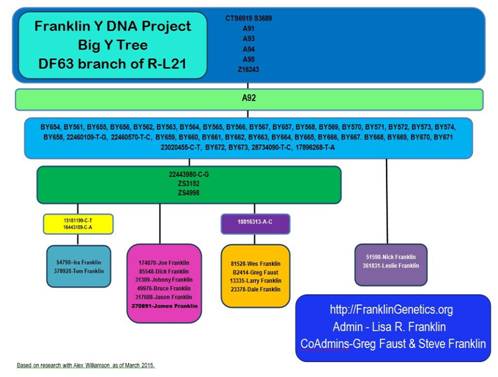
There are many Franklin male lines in the United States, England and worldwide that cannot be connected by data from documents. This project should allow some judgments to be made about how closely related these several Franklin male lines are. The first and foremost goal of this project it to sort the Franklin (and variants i.e Frankling, Franklyn, Frankland) families into their correct family groups as indicated by Y DNA. Thus far the Franklin project has identified 22 distinct Franklin family groups using Y DNA testing.
Using Benjamin Franklin's Y-Chromosome to Settle Some Family Traditions about Relationships to Benjamin -- There are no known living Franklin surnamed men descended from either Benjamin Franklin, statesman or his father Josiah Franklin as all male lines descended from Josiah via his sons have "daughtered out". Therefore, it has been determined that the most likely method for obtaining a Y DNA Franklin male participant carrying the Y DNA signature of the ancestral lineage of Benjamin Franklin, statesman will come from documenting and tracing the ancestors of the male Franklin children of Benjamin's great grandfather,
Many of the testees are in the R1b1 haplogroup, the largest European haplogroup.
Project Progress
|
|
Family
Tree DNA Results Chart by kit # |
|
Project
Participants Franklin Patriarchs |
|
Shared Franklin
research resources |
Project Stories:
Admin, Lisa R.
Franklin's story:
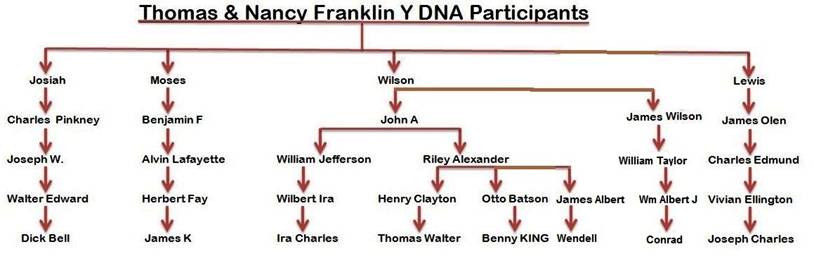
I am the administrator for
the Franklin Y DNA project at Family Tree DNA (FTDNA). This project was
begun in 2001 by Mr. David Roper in an attempt to learn more about his Franklin
lineage. The project involves DNA testing by a simple, painless and easy
cheek swab procedure. The test is highly specific and tests only the male
Y chromosome which is passed relatively intact from father to son.
Because it is so specific, it allows us to determine which Franklin men are
related and can help us all to trace our Franklin ancestors further back.
Indeed, in 2007 my father,
Ira approached me after reading about this test and asked me if I thought it
might help us get past our 20 year brick wall with his Franklin ancestry.
We had been stuck in Alabama forever! I did some research, and learned
that the test involves sending you back results that provide STR results, a
string of numbers that are good when compared to someone else’s string of
numbers to determine any kinship. I told Dad this and we decided he
should test and see what happened. He had a match come up that directed
us to Pulaski County, GA where we went to the courthouse and found
documentation that tied our Franklins in Alabama back to that county in Georgia
and OVER THE WALL WE WENT…from Alabama, back to Georgia and on to
ENGLAND! It was exciting for us both!!
Since that time, experience
has taught us that one of the
biggest keys is having as much participation as you can. Having said that, we have already had
great success placing many of our nearly 200 participants into family groups
based on their DNA results & traditional genealogy and there is no reason
why we cannot accomplish the same with other Franklins worldwide using this
same methodology. For myself, now researching in England, I am hoping we
might have some Franklin men living in England with Franklin ancestors there
who might consider testing in our project to learn more about their
ancestors. This would assist us in that a match to someone there would
indicate a starting location for my own Franklin research.
Please take a look around
this website and consider joining us, as we would love to have your
participation! One never knows what you might learn. As more
Franklin men test in the project we obtain new information that may lead us to
new family connections.
If you have any questions, or
we can be of any assistance, please don’t hesitate to contact us.
Sincerely,
Lisa R. Franklin
David Roper's
story:
Many Franklin families, including that of David Roper's mother's, have a tradition that they are related to Benjamin Franklin (b 1706 d 1790), the statesman. In my role as a genealogist of Franklin families I get e-mails regularly with such assertions.
If the Y-chromosome of Benjamin's could be extracted from, say, a tooth of his, these assertions could be tested. (A hair does not work for male lines unless it contains its follicle or some attached skin cells; it does work for female lines using the mitochondria DNA. See: http://www.promega.com/profiles/502/ProfilesInDNA_502_11.pdf) Perhaps more feasible would be extraction of the Y-chromosome from the DNA of a few known male-line relatives of Benjamin's.
Mr. Roper proposed to do such an extraction and publish the pattern (called haplotype) so that some of the Franklin families' traditions can be tested. This would be the ultimate artifact of Benjamin Franklin. (More information about Benjamin Franklin's DNA: Benjamin Franklin's DNA.)
If no tooth or known male-line relative of Benjamin's becomes available for testing, it still may be possible to use Y-chromosome tests to make more plausible suspected relationships of Franklin families to Ben. If many Franklin males (not those whose known ancestor changed his name to Franklin and not those whose female Franklin ancestor gave her children Franklin as a surname) have their Y-chromosome tests done and all or a large fraction have the same Y-chromosome, and many of these families have legends that they are related to Ben, then it would be plausible that, indeed, they are related to Ben.
Congress established the Benjamin Franklin Tercentenary Commission, one of whose duties is to do: "The acquisition and preservation of artifacts associated with Benjamin Franklin." Information about Benjamin Franklin's DNA would be the ultimate artifact associated with him.
Elementary genetics teaches that a human egg becomes a female embryo when a sperm gives it an X-chromosome and a male embryo when the sperm gives it a Y-chromosome. Thus, the Y-chromosome is passed down suceeding generations only through the male line. The only change from one generation to the next is by random infrequent mutations. Over long periods mutations do occur, so one can determine male paternal lineage by comparing the DNA coding of Y-chromosomes.
There are "junk" regions (that have no effects on inherited traits) on the Y-chromosome that contain repeated base-pair sets (called microsatellites or Short Tandem Repeats or STR). Over time the number of repeats changes due to random mutations. Since these mutations have no effect on inherited traits, they are propagated into suceeding generations. The number of repeats, called alleles or markers, at these locations can be used to distinguish different male-line families. Thus, the detailed structure in terms of base-pair coding is not required; only information about certain aspects of a small part of the Y-chromosome is needed. This does not identify the individual, but only the family to which the individual belongs; determining the 12 or 25 markers is much less information than that obtained by totally sequencing the Y-chromosome.
This was recently done (http://uvamagazine.org/articles/anatomy_of_a_mystery/) for descendants of a slave woman, Sally Hemings, with the result that one of her sons had a Jefferson Y-chromosome, either from Thomas Jefferson or one of his near male relatives.
Several families have used the Y-chromosome to determine the closeness of relationships in the male lines, and many more projects are underway. You can see Family Tree DNA's main page to search for available projects.
Once Ben's Y-chromosome pattern is determined, any male-line Franklin could have his Y-chromosome pattern tested to compare it to Ben's to determine if he is indeed related to Ben.
Perhaps a more important result of testing many male-line Franklins would be that sets of Y-chromosome markers would be determined for different Franklin families and rare random mutations for branches of those families would provide identity markers for the branches of those Franklin families. To see how this has worked out for the Roper family, see http://www.roperld.com/roperconnect.htm.
David Roper’s FY01 Franklin Family Group
A number of men descended from Reuben Franklin who married
Margaret Peachy and his brother Henry M. Franklin who
married Margaret Hensley have done Y
DNA testing and there is a proven NPE in this Franklin line which matches descendants of the Long family of Virginia that includes Broomfield Long. Furthermore, research by the Franklin Genetics project
over the last few years turned up documents in Virginia naming Henry as Henry Franklin alias Henry Long and Henry Franklin alias Harry Long.
25 July 1737 First court record for young Henry. He had probably just turned 21. Henry Franklin alias Henry Long is mentioned as a juror or witness in a case between John King and Larkin Chew in Spotsylvania County, Virginia.
7 February 1738 Defendant in Trepass Case in Spotsylvania County. Multiple court records/hearings in 1738 in the Trespass action between MARY CURTIS an Infant by RICE CURTIS JUNR. Gent.. her next friend, against HENRY FRANKLYN alias HARRY LONG Deft. for Ten pounds Sterling damage.
------------------------------------------------------------------------------------------------------------
If you are a male-line Franklin and would be interested in participating in this project, please eMail: FranklinGenetics@gmail.com.